AI Marketing Bots for Brand Teams: 7 Workflows, Risks, and a Buying Checklist
A practical guide to choosing AI marketing bots that fit a real workflow, protect brand standards, and produce results your team can inspect.
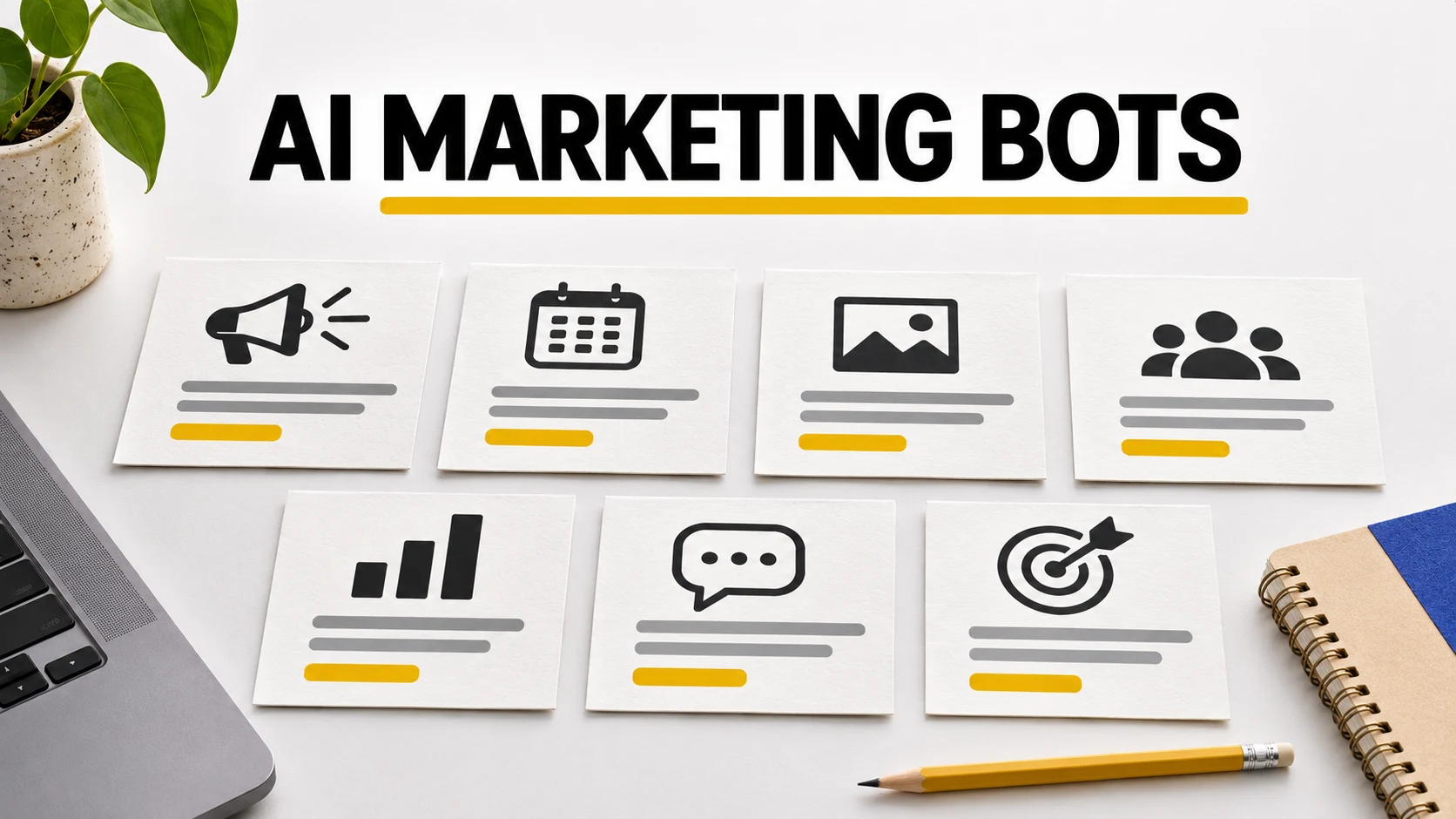
AI marketing bots can sort enquiries, draft campaign material, monitor performance, and answer routine questions. A useful bot has a narrow job, approved source material, a human owner, and a measurable output. Brand teams should buy the workflow and its controls, not a long feature list.
The fastest route to a bad purchase is asking a vendor whether its bot can “do marketing.” Ask whether it can complete one repeatable task inside your current process without weakening accuracy, brand voice, privacy, or accountability.
This guide compares seven AI marketing bot use cases, shows where people must review the work, and gives you an AI marketing bot buying checklist for vendor calls. It is written for marketing leaders, content teams, and founders deciding whether automation belongs in a campaign workflow.
Seven workflows at a glance
Start with one task that happens often, has clear inputs, and creates a visible cost when it goes wrong. The table maps seven practical workflows to a human gate and a useful measure.
| Workflow | Approved input | Bot output | Human gate | Useful measure |
|---|---|---|---|---|
| Customer question routing | Current FAQ, policies, product facts | Answer, category, or handoff | Review low-confidence and sensitive replies | Correct resolution rate |
| Lead qualification | Agreed fields and qualification rules | Score, label, missing questions | Sales reviews before outreach | Accepted lead rate |
| Content first drafts | Brief, source pack, brand rules | Draft copy or outline | Editor checks facts, voice, and claims | Approval after edit |
| Campaign variants | Approved concept and fixed claims | Copy, format, or audience variants | Campaign owner approves every live asset | Valid test variants |
| Social response triage | Response rules and escalation list | Category and suggested reply | Community manager handles risk cases | Response time and correction rate |
| Campaign monitoring | Platform data and alert thresholds | Anomaly alert with context | Media lead decides the action | Useful alert rate |
| Reporting summaries | Clean campaign data and definitions | Weekly summary and questions | Analyst verifies totals and meaning | Review time saved |
1. Route routine customer questions
An AI chatbot for marketing teams can identify whether a question concerns a product, delivery, partnership, press request, or support issue. It can answer only when the source contains an approved response, then send everything else to a person.
This is safer than giving a public chatbot permission to improvise. The team should define restricted topics, uncertainty rules, and a maximum age for product facts. Review a sample of resolved and escalated conversations each week. A high containment rate is not a win if the bot confidently gives the wrong answer.
2. Qualify and enrich leads
An AI bot for lead qualification can extract company size, market, timeline, service interest, and missing information from an enquiry. It can then place the lead in a queue or ask one approved follow-up question.
Keep the scoring logic visible. Sales should know why a lead received a label and be able to correct it. Measure the percentage of bot-qualified leads that sales accepts, plus the rate at which the bot sends promising enquiries to the wrong queue. Do not train the system to prefer a protected characteristic or an unreliable proxy for buyer quality.
3. Create content first drafts
An AI bot for content creation works best after the team supplies a brief, original research, current product facts, audience context, and examples of acceptable voice. It can produce an outline, caption options, interview questions, or a first draft for an editor.
Google’s guidance for AI-assisted website content asks publishers to focus on accuracy, quality, and relevance, including titles, descriptions, structured data, and image text. It also warns against generating many pages without adding value. Publish the editor’s work, not the model’s first response. See Google’s guidance on generative AI content.
4. Produce controlled campaign variants
Good AI marketing automation workflows separate the fixed parts of a campaign from the parts a team wants to test. A bot might preserve the approved product claim and call to action while varying the opening line, audience example, or short-form edit.
Every variant should answer a test question. “Create 50 ads” produces volume without a decision. “Create three opening frames that express the same benefit for first-time buyers” gives the team a controlled comparison. The campaign owner still approves the final asset and records which variable changed.
5. Triage social media responses
An AI bot for social media responses can label praise, product questions, complaints, spam, creator enquiries, and safety concerns. It can suggest replies for low-risk categories while sending complaints, legal issues, and sensitive personal information to a community manager.
Build AI chatbot brand voice guidelines from real approved responses rather than adjectives such as friendly or bold. Include phrases the brand uses, phrases it avoids, spelling conventions, response length, and examples of when a plain apology is better than a witty reply.
6. Monitor campaigns and flag anomalies
An AI bot for campaign monitoring can watch agreed metrics and notify the team when spend, delivery, click quality, conversion tracking, or comment sentiment moves outside a defined range. The alert should name the metric, time window, comparison point, and source.
The bot should not pause media because one number moved. Tracking failures, delayed conversions, promotions, and platform reporting changes can all create false alarms. Let the media lead decide whether to investigate, change the budget, or leave the campaign alone.
7. Summarise reports and surface questions
A reporting bot can combine approved data into a weekly narrative, compare results with the plan, and identify questions for an analyst. This can reduce repetitive formatting while keeping interpretation with the team.
Define every metric before connecting the bot. “Lead,” “qualified enquiry,” and “opportunity” must mean the same thing in the source systems and the report. Track correction time, missing-data flags, and whether the summary helped someone make a decision. These are stronger AI marketing bot success metrics than the number of reports generated.
AI marketing bot vs marketing automation
The AI marketing bot vs marketing automation decision depends on how predictable the task is. Traditional automation follows explicit triggers and rules. An AI bot can interpret less structured input and produce a variable response, which creates more flexibility and more review work.
| Choose | Best fit | Main strength | Main risk |
|---|---|---|---|
| Rule-based automation | Known triggers and fixed actions | Predictable and easy to audit | Breaks when input falls outside the rule |
| AI marketing bot | Language, classification, drafting, summarisation | Handles varied input | Can return plausible but incorrect output |
| Combined workflow | AI interpretation followed by fixed actions | Flexible input with controlled execution | Poor handoffs can hide errors |
For example, an AI bot can classify an enquiry, but a rule should decide which CRM queue receives the approved category. This keeps the uncertain step separate from the irreversible action. Work With AI’s Ad Tech practice can help connect this kind of workflow to tracking, campaign operations, and reporting.
Risks of AI bots in marketing
The main risks of AI bots in marketing are inaccurate claims, stale context, privacy failures, biased decisions, copyright problems, weak disclosure, and unattended publishing. Each risk needs a named control and owner.
The NIST Generative AI Profile recommends documented roles, testing, monitoring, human oversight, and attention to third-party systems across the AI lifecycle. A practical AI marketing bot governance record should include the bot’s purpose, approved data, owner, review gate, known failure cases, vendor dependencies, and retirement rule.
For AI marketing bot data privacy, ask what customer information enters the system, where it is stored, how long it remains, whether the vendor uses it for training, and how access is revoked. Keep sensitive personal data out of prompts unless the use has been reviewed and the contract supports it.
The US Federal Trade Commission has stated that existing consumer protection law still applies to AI. Unsupported claims remain unsupported when software writes them. Its joint statement on automated systems is a useful reminder that a vendor’s AI label does not remove legal duties.
Human review for AI marketing
Use human review for AI marketing at the point where an output can affect a customer, budget, public claim, or brand reputation. Low-risk classification can be sampled. Public copy and sensitive replies should receive direct approval until testing proves that a narrower review method is safe.
Keep an audit trail for material work: input, source version, output, reviewer change, approval, and final destination. The record makes a bad response easier to trace and a vendor easier to evaluate.
HubSpot Academy’s free video lesson, Context Engineering: Your AI Blueprint for Marketing Success, explains persistent context, autonomous agents, and feedback loops across four short videos. It is a useful companion before your team designs its first controlled workflow.
How to choose an AI marketing bot
If you are deciding how to choose an AI marketing bot, take one real task and five difficult examples into every demonstration. Ask the vendor to show the system failing, escalating, and recording a correction. A polished happy path tells you little about operational fit.
Use these ten buying questions:
- What exact input starts the workflow, and which output ends it?
- Which sources can the bot use, and how does the team remove stale material?
- Can it cite or expose the source behind an answer?
- Which actions require approval, and can the team change those gates?
- How does it handle uncertainty, complaints, and restricted topics?
- What customer data does the vendor store, share, or use for training?
- Can administrators review inputs, outputs, edits, and access history?
- Which systems does it connect to, and what happens when one fails?
- How will the team measure correction rate, accepted output, and business value?
- How can the company export its data and stop the service?
This AI marketing bot buying checklist turns a vendor demo into a workflow review. It also helps teams compare a packaged tool with a tailored system. Our guide to marketing automation platforms versus custom AI agents covers that build-or-buy choice in more detail.
A 30-day AI marketing bot implementation plan
A cautious AI marketing bot implementation plan can produce useful evidence in one month without handing the system a public channel.
| Week | Team action | Evidence to keep |
|---|---|---|
| 1 | Define one task, owner, source pack, restricted actions, and baseline | Current time, error rate, and volume |
| 2 | Test normal, ambiguous, outdated, and hostile inputs in a closed environment | Output, source, reviewer decision, failure type |
| 3 | Run beside the existing process with approval on every output | Correction rate, escalation rate, time per approved task |
| 4 | Decide whether to expand, revise, pause, or replace the bot | Business result, risk log, next control |
The first launch should stay narrow. AI marketing bots for brand teams earn a wider role only after the team can explain their inputs, inspect their decisions, and show that the output is useful. To understand how AI marketing bots work inside a larger campaign, connect the approved output to the planning and reporting system around it. Work With AI’s Marketing practice can shape that workflow, while the Branding practice can define the voice and message rules the bot must follow.
Research sources
- NIST Artificial Intelligence Risk Management Framework: Generative Artificial Intelligence Profile
- Google Search guidance on generative AI content
- FTC, Joint Statement on Enforcement Efforts Against Discrimination and Bias in Automated Systems
- HubSpot Academy, Context Engineering: Your AI Blueprint for Marketing Success