When One CEO Becomes Infrastructure: What the Jensen Huang Investigation Reveals About Global AI Risk
The unresolved investigation is bigger than one executive. It exposes how much of the global AI economy depends on one company, one supply chain, and one unusually visible founder.
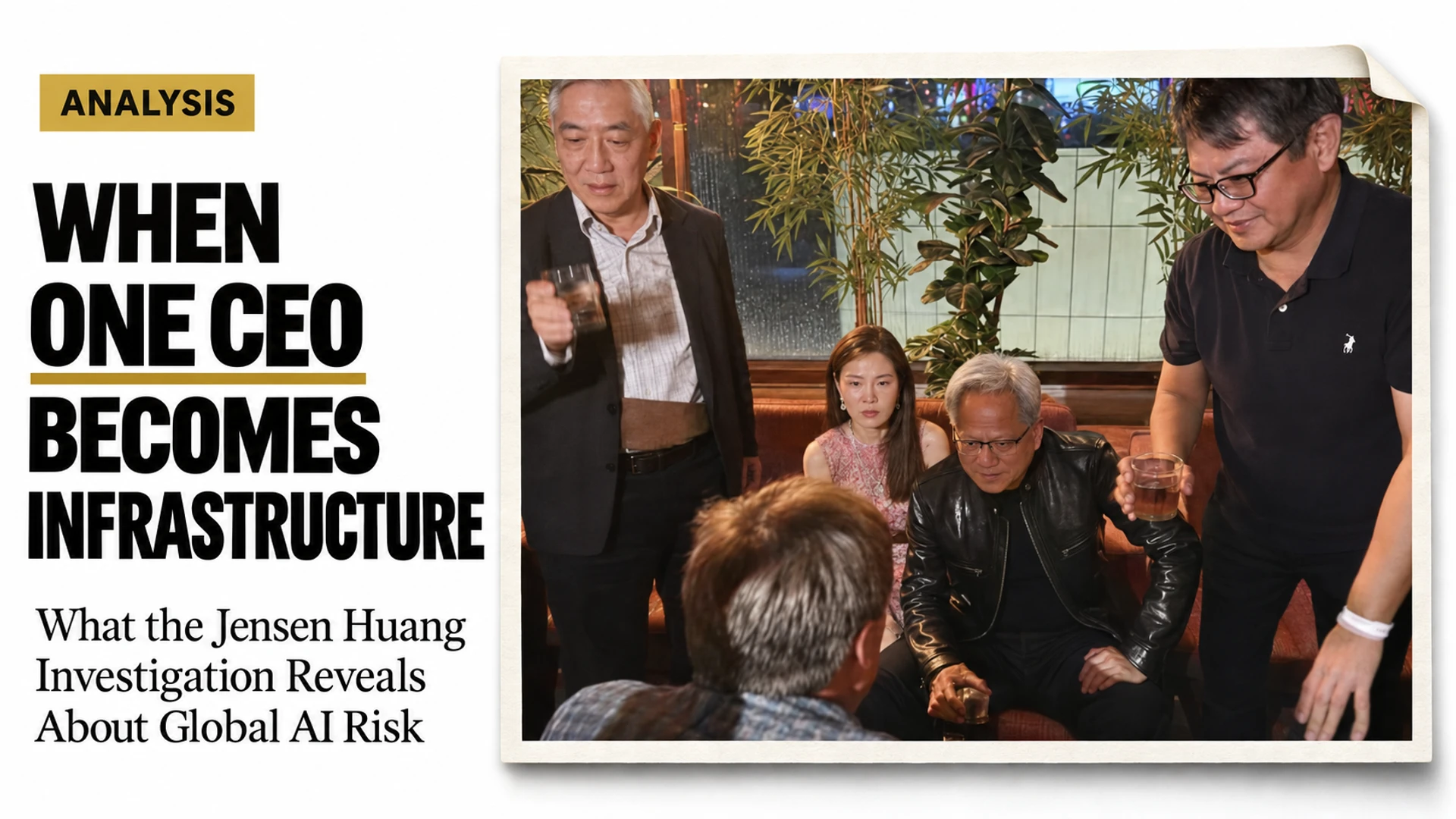
The Jensen Huang Nvidia investigation matters globally because Nvidia is not an ordinary technology supplier and Huang is not an ordinary chief executive. Nvidia's board said on November 8, 2026 that it had opened an independent investigation after reports that Huang was the target of a foreign intelligence effort. The board also said it had no reason to believe national security or Nvidia confidential information had been compromised, and that Huang remained in his role with the board's support.
Those are the verified facts. The allegations behind the investigation remain unresolved, China has denied them, and Nvidia says its operations continue. The responsible question is therefore not whether an unproven story is true. It is what the Jensen Huang investigation and global AI risk reveal about an industry that has concentrated extraordinary technological, commercial and narrative power in one company and one highly visible founder.
The immediate effect is confidence risk, not evidence of a broken chip supply. The longer-term exposure sits in export approvals, government relationships, partner diligence, succession readiness and brand trust. For business leaders, this is a case study in treating reputation, leadership and infrastructure as one connected system.
What is confirmed, and what is not
Nvidia's board statement says independent directors retained outside counsel and began an investigation. It states that Huang is cooperating, remains chief executive, and has the board's support. In a separate message to Nvidia employees, Huang acknowledged marital infidelity, apologised and said he would cooperate. Neither statement confirms that company information or national-security material was transferred.
The Associated Press reported the allegations, China's denial and Nvidia's response. A shareholder lawsuit has also been filed, but a lawsuit is an allegation, not a finding. Searches for how a CEO scandal affects a company are understandable; “scandal” is still too definite a label for an investigation whose central claims have not been established.
| Signal | Verified now | Why it matters |
|---|---|---|
| Board action | Independent investigation with outside counsel | Governance is active, but the scope and timeline are not public |
| Leadership | Huang remains CEO and has board support | No announced operational transition |
| Company information | Nvidia says it has no reason to believe secrets were compromised | No verified supply or security breach |
| Market response | Shares fell after the reports; suppliers reported limited immediate disruption | Confidence moved faster than contracts |
| Policy exposure | No new restriction has been tied publicly to the investigation | Future scrutiny remains a scenario, not a fact |
Why this became a global AI story
Nvidia sits near the centre of the compute layer used to train and run many advanced AI systems. The OECD's review of competition in AI infrastructure cites estimates above 80% for Nvidia's share of the AI GPU market and describes the accelerator market as highly concentrated. That does not mean every AI workload uses Nvidia, or that alternatives do not exist. It does mean a confidence shock around Nvidia travels farther than a typical executive-news cycle.
This is AI infrastructure concentration risk in practical form. The exposure is not limited to a single chip. Developers learn a software ecosystem, cloud providers commit capital to compatible systems, governments assess access to strategic compute, and enterprises plan products around available capacity. Each layer creates switching costs and shared dependency.
It also explains why Nvidia AI chip market dominance has become a business-continuity question. The issue is not that one investigation will stop data centres. The issue is that procurement, policy, investor confidence and leadership credibility all touch the same narrow point in the stack.
Nvidia leadership risk is different from ordinary CEO risk
Huang co-founded Nvidia in 1993 and has served as chief executive and a director since the company's beginning, according to Nvidia's 2026 annual report. He does more than run the company. He explains its technology to developers, makes the case for national AI infrastructure to governments, reassures investors about demand and turns product launches into global industry events.
That creates Nvidia key person risk: knowledge, relationships, credibility and public narrative become unusually concentrated in one leader. The risk is not a prediction that Huang will leave. It is the operational fact that many stakeholders associate their confidence in Nvidia with his presence and explanation.
A related founder-led company reputation risk appears when the founder's identity and the corporate story become difficult to separate. A product-led company can replace a spokesperson more easily than a company whose spokesperson is also its strategist, origin story and most effective translator. That is why brand governance has to include executive visibility, not just visual identity and campaign approvals.
The immediate effect: confidence moved before contracts did
Nvidia's shares closed about 4% lower after the reports, while a Dow Jones account carried by MarketScreener found limited immediate reaction among Asian suppliers. Analysts cited there noted that demand and existing contracts were not directly affected. That distinction matters: market prices absorb uncertainty instantly; factories, cloud capacity and purchase commitments usually change only when the underlying commercial assumptions change.
The best current reading of global AI supply chain risk is therefore “heightened attention,” not “physical disruption.” Nvidia reported roughly 42,000 employees across 38 countries in its 2026 filing. Its ecosystem spans chip fabrication, advanced packaging, memory, servers, networking, data centres, cloud platforms and software. One leader's reputation can influence confidence around that system, but it does not personally operate every link.
Still, AI GPU supply chain dependence deserves a place on enterprise risk registers. A team that cannot name its alternative cloud region, accelerator class, model-serving option or migration cost does not have resilience; it has hope.
Where second-order effects could appear
1. Export controls and government relationships
Nvidia already operates inside US China AI chip tensions. Its latest SEC filings describe export restrictions, licensing requirements and requests from regulators as material operating issues. An investigation involving alleged foreign influence could produce more questions from policymakers even if it finds no compromise. That is a plausible pathway, not a confirmed outcome.
For buyers, AI export control risk affects product availability, regional specifications, cloud access and the useful life of infrastructure investments. Teams planning cross-border AI products should model policy changes separately from ordinary vendor delivery risk.
2. Partners, cloud providers and enterprise buyers
Large customers do not need to abandon a vendor to tighten diligence. They can request additional security assurances, review contractual rights, revisit concentration limits or delay a public co-marketing moment. These small decisions accumulate. They are how vendor concentration risk in AI can move from a procurement spreadsheet into launch timing and customer communication.
Work With AI's Ad Tech work treats platform dependency similarly: map the system, identify who owns the data and access, and decide what continues if one supplier or account becomes unavailable. The same discipline applies to AI infrastructure, only with higher switching costs.
3. Succession and organisational confidence
Good AI company succession planning is not a secret list of possible chief executives. It is proof that strategy, technical authority, government relationships, customer confidence and public explanation can continue across a leadership transition. Nvidia's scale makes that capability strategically relevant even without a planned change.
The board does not need to publish confidential succession details, but investors and partners will watch for evidence that senior leaders beyond Huang can represent the company. Nvidia succession planning becomes credible when the organisation visibly distributes authority before it is forced to.
When the founder becomes the product story
The accompanying Milken Institute conversation shows why Huang is central to Nvidia's narrative. He moves between chips, data centres, national policy, jobs and the economics of AI in one discussion. The interview is not evidence about the investigation; it is evidence of how much explanatory work the CEO personally performs for the wider ecosystem.
This is the core Nvidia leadership risk. The company needs its technology story to remain legible even when its most effective storyteller is under scrutiny. Brands that build every major launch, belief and relationship around one personality eventually discover that visibility is both an asset and a dependency.
What brands and AI teams should audit now
This story is useful even for companies that never buy a physical Nvidia system. It offers a concrete framework for business continuity for AI companies and for any brand whose growth depends on a founder, platform or strategic technology vendor.
- Map the dependency. List the vendors, executive relationships, software layers, data rights and regions that a critical AI workflow needs.
- Define a viable fallback. Record the time, cost, performance trade-off and approvals required to move workloads or communications.
- Distribute authority. Give more than one technical and commercial leader the context and visibility to explain important decisions.
- Separate scenarios. Build different responses for an allegation, a verified policy action, an operational outage and a leadership transition. They are not interchangeable.
- Prepare stakeholder messages. Customers, employees, investors and partners need different answers, but each answer must use the same verified fact base.
Our guide to AI content governance and quality assurance provides the publishing controls for that last step. The broader principle is simple: speed is useful only when the approval chain protects accuracy.
How to communicate during an unresolved investigation
A sound corporate crisis communication strategy begins by separating what is known, alleged, being investigated and operationally affected. Nvidia's first board statement does those jobs in a compact order: it names the investigation, identifies independent oversight, states Huang's cooperation and describes the board's current confidence. What it cannot yet provide is a final conclusion.
Research synthesised by the Institute for Public Relations shows why responsibility and stakeholder protection shape crisis response. Organisations create additional risk when they deny too much too early, speculate beyond the evidence or communicate in ways that appear to minimise stakeholder concerns.
The most useful board response to a CEO crisis has five visible parts: independent oversight, a defined fact-finding process, operational continuity, a commitment to update stakeholders and clear consequences if findings require them. Support for a leader and independence of investigation must be communicated as separate ideas.
For teams asking how leadership crises affect brand trust, the answer is less about one perfect statement than about consistency across later actions. People compare the first message with the final findings, the board's decisions, employee treatment and whether the company corrected anything it previously said.
The practical crisis communication lessons for brands are to publish only verified facts, name the decision owner, avoid anonymous speculation, keep a dated record of updates and align legal review with plain language. Our marketing and communication team can help turn that discipline into a stakeholder message system rather than a one-off press response.
What to watch next
- Scope and timing: whether Nvidia provides a clearer investigation timetable or material updates.
- Board independence: how outside counsel and independent directors describe their process and conclusion.
- Policy signals: any formal action from US or other governments, rather than commentary alone.
- Customer behaviour: changes in orders, cloud commitments, partnership announcements or diligence requirements.
- Leadership visibility: whether other Nvidia executives take on more strategic and public responsibility.
The durable conclusion is not that one unresolved investigation will derail the AI economy. It is that the economy has allowed technical supply, policy access and public confidence to converge around unusually few institutions and people. The next resilient AI strategy will not merely ask which model performs best. It will ask who and what the business cannot continue without, then build a tested alternative before the answer becomes urgent.