Can Kling Image 4.0 Produce a Real Brand Campaign, Not Just One Good Image?
Kling Image 4.0 promises 8K, stronger text and coherent image series. This teardown asks whether those features can survive a real brand campaign workflow.
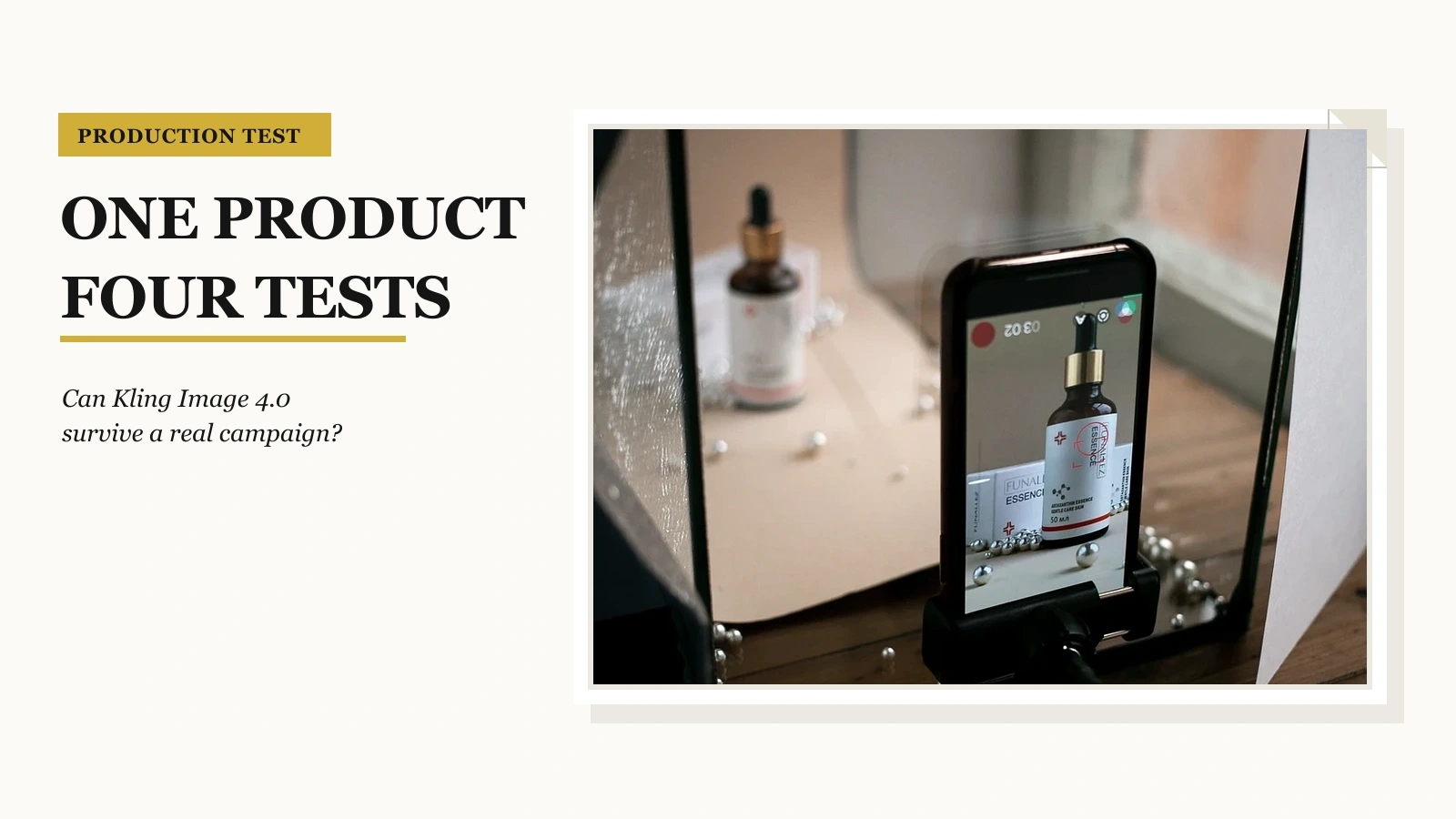
Kling Image 4.0 has the specifications of a serious commercial image system: native 8K output, long text rendering, product references, coordinated image series, colour controls, and long ecommerce layouts. The important question is not whether it can make one attractive frame. It is whether one approved product can survive packshot, key visual, social adaptation, and campaign-series production without losing identity.
This Kling Image 4.0 review separates three kinds of evidence. Kling’s launch materials describe the intended capabilities. Official API documentation defines how the model can be used and where limits apply. Independent hands-on tests show promising text, resolution, and series results, while also revealing invented copy, product drift, and detail changes. Work With AI has not run its own controlled product test, so this is a campaign-readiness teardown, not a claim that the model has passed WWA production approval.
The answer today is: Kling Image 4.0 looks capable of accelerating concept and asset development, but a real brand campaign still needs reference-led generation, manual quality control, and conventional finishing. Production-ready AI creative is a workflow verdict, not a launch-page feature.
What Kling Image 4.0 officially offers
Kling says the model supports native high-resolution output, coordinated series of up to ten images, long-form ecommerce creative, typography across multiple languages and fonts, colour presets, and reference-guided generation. Its API guide says standard image generation can use up to ten reference assets and its long ecommerce workflow requires one to three product images.
The resolution claim needs precision. Standard generation supports Kling Image 4.0 native 8K as a selectable tier. The separate long-image endpoint is documented at 1K or 2K. A brand should not assume every output mode produces an 8K asset.
Likewise, Kling Image 4.0 ecommerce images can be generated as one long product page, but the API manual tells users to verify generated copy and product facts. This matters because a polished page can still contain an incorrect measurement, benefit, or invented label.
| Claim or capability | Evidence available | Production question |
|---|---|---|
| Native 8K output | Official tier plus independent files at high pixel dimensions | Does fine detail remain believable at final use size? |
| Long text rendering | Independent posters reproduced substantial requested copy | Does it add unapproved words or alter microcopy? |
| Series generation | Independent sets showed strong broad continuity | Do product geometry, labels, and small details remain fixed? |
| Reference-guided product work | Official support for multiple references | How often does the approved product need repair or compositing? |
| Long ecommerce pages | Official workflow, with mixed independent results | Can every claim, specification, and layout survive review? |
One good image is not a campaign system
An AI image generator for brand campaigns must preserve more than mood. A product’s silhouette, proportions, cap, label, logo, colour, finish, and claims may all be controlled assets. The background can change while those facts remain stable.
Independent tests help define the gap. PhotoWorkout reported a 9984 by 6656 file from its 8K realism test, strong long-text performance, and a coherent four-frame story. It also found painterly fine detail at close inspection, invented microcopy, and camera drift across a series. Each Labs found accurate requested poster text and a consistent four-image story, but its product prompt produced a plausible object rather than the exact product form described.
Those are useful signals for Kling Image 4.0 commercial creative. They are not proof that a regulated pack, distinctive bottle, or precisely approved logo will remain unchanged across a paid campaign.
The four-part brand campaign test
A credible Kling Image 4.0 brand campaign test should begin with a real approved product and a locked source pack. Use front, back, side, three-quarter, label, material, and colour references. Record every prompt, setting, output, rejection, edit, time, and cost.
Test 1: the packshot
The Kling Image 4.0 packshot test should ask for a neutral studio image before a cinematic scene. Compare silhouette, proportions, closure, label position, logo, mandatory copy, colour, reflections, and shadows with the source photographs.
A useful score is pass, repairable, or reject. Pass means the product could be published after normal colour and retouching. Repairable means a compositor can fix the issue without rebuilding the asset. Reject means the product identity or legal information changed.
Test 2: the key visual
The Kling Image 4.0 key visual test should place the same product inside a campaign idea with a deliberate camera angle, lighting rule, composition, colour palette, and safe space for copy. The objective is not only beauty. It is whether the approved product still looks identical when the scene becomes more complex.
Kling Image 4.0 product photography may be useful for exploring sets, materials, lighting, and crop variations before a shoot. A brand should still compare the generated frame with actual product photography and disclose synthetic imagery where law, platform policy, or audience expectation makes that necessary.
Test 3: social adaptations
Create landscape, square, portrait, and vertical versions from the approved direction. Evaluate whether Kling Image 4.0 social media assets keep the hero product, hierarchy, and negative space consistent rather than merely producing four related pictures.
The Kling Image 4.0 typography test belongs here. Use only approved copy, prohibit extra text, and inspect every character. Independent tests show that Kling can render substantial text well, but also that it may invent headings, dates, or footer copy. Correct spelling is not the same as copy control.
Test 4: the campaign series
Ask for a sequence that changes setting or use case while keeping the product fixed. An AI image series consistency test should compare the product across frames at pixel level and through a human brand review.
Kling Image 4.0 image series appears to be one of the model’s strongest new capabilities. The official workflow supports coordinated sets, while independent tests report stable characters and broad scene continuity. The remaining commercial question is Kling Image 4.0 product consistency: can small product facts survive the same sequence?
Use a weighted production scorecard
| Review area | Weight | Pass condition |
|---|---|---|
| Product identity and geometry | 25% | Approved product remains recognisable and dimensionally credible |
| Label, logo, and required copy | 20% | No invented, missing, or changed text |
| Series consistency | 15% | Controlled details persist across all selected frames |
| Creative direction | 15% | Composition, light, colour, and brand tone match the brief |
| Adaptation quality | 10% | Each format is composed for its placement |
| Repair effort | 10% | Corrections take less time than the chosen alternative |
| File and delivery fitness | 5% | Resolution, colour, crop, and export meet channel needs |
This makes brand-consistent AI images measurable. A team should calculate first-pass acceptance, average repair time, rejection reasons, and final cost per publishable asset. Generation speed alone can hide a slow approval and correction process.
Reference images need a controlled source pack
Kling Image 4.0 reference images can include multiple approved assets, but more references do not automatically produce better control. Give every image a role: front geometry, side geometry, label, material, colour, or usage context. Avoid mixing outdated packaging and current packaging in one request.
For consistent product images with AI, write preservation rules separately from creative instructions. State which details may change, which must remain fixed, and which output should be rejected automatically. The prompt should not ask the model to infer a back label that is not shown.
This is the foundation of an AI product photography workflow: approved source assets, explicit preservation rules, low-cost concept rounds, a selected direction, high-resolution generation, brand review, legal or claims review where required, retouching, and channel exports.
Where Kling may fit today
Kling looks most useful for concept exploration, campaign compositions, editorial visuals, storyboards, environment variations, and adaptable social series where minor details can be reviewed and fixed. It may also accelerate product-page exploration when every generated claim is checked against approved data.
It is a riskier choice for packs with dense regulated copy, products whose geometry is legally or functionally important, exact before-and-after claims, or high-volume localisation without a rigorous review system. The more a campaign depends on exact identity, the more the output should be treated as a generated source layer rather than a finished master.
An AI campaign asset system still needs conventional design and production tools. Use generation to create options and source material. Use layout, compositing, retouching, colour management, version control, and human approval to finish the campaign.
Work With AI’s AI generation practice connects model selection with creative production. Our branding team can define the fixed and flexible parts of the system, while advertising specialists can turn the chosen direction into placement-ready assets. For the related video model, read our Kling 4.0 video analysis.
The verdict: promising, but the campaign must pass as a system
Kling Image 4.0 has moved the conversation beyond one impressive image. Independent evidence supports real progress in resolution, text rendering, and coordinated series. The same evidence also shows why exact product form, unrequested copy, and small-detail drift remain production concerns.
Before publishing a campaign, put one product through the four tests and count what survives. If the product stays exact, the typography stays controlled, the adaptations feel designed, and repair time remains lower than the alternative, the model has earned a place in the workflow. Until then, the feature list is a hypothesis.