Self-Hosting AI Workflow Automation: The Complete Guide to Building Secure and Scalable AI Systems
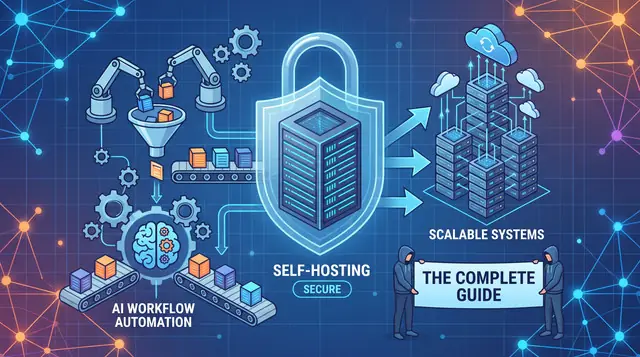
Self-Hosting AI Workflow Automation: Is It the Future of Enterprise AI?
Imagine running powerful AI workflows without depending on third party cloud platforms for every request.
No usage limits. No vendor lock in. Complete control over your data.
That is exactly why more businesses are shifting toward Self-Hosting AI Workflow Automation. Whether you are building AI agents, automating business processes, or handling sensitive customer information, self-hosting gives you the flexibility and privacy that cloud-only solutions often cannot.
In this guide, you'll learn what self-hosting AI workflow automation means, why companies are adopting it, and how you can build your own reliable AI infrastructure.
What Is Self-Hosting AI Workflow Automation?
Self-Hosting AI Workflow Automation is the practice of running AI-powered automation workflows on your own servers or private infrastructure instead of relying entirely on external cloud providers.
These workflows may include:
- AI chatbots
- Document processing
- Customer support automation
- Sales and marketing workflows
- Internal business operations
- AI agents connected to multiple applications
Instead of sending every request to a hosted platform, you manage the infrastructure, compute resources, databases, and security yourself.
This provides complete ownership over both your automation pipeline and your data.
Why Businesses Are Moving Toward Self-Hosted AI
Cloud platforms make getting started easy.
However, as AI adoption grows, organizations begin facing challenges like rising API costs, stricter compliance requirements, and concerns about sensitive business information.
Self-hosting solves many of these issues.
Better Data Privacy
Your business data stays inside your own infrastructure instead of being processed through multiple external services.
This is especially important for industries handling confidential customer information.
Lower Long-Term Costs
Although initial setup requires investment, self-hosting often becomes significantly more economical as workflow volume increases.
Instead of paying per request, you utilize your own computing resources.
Complete Customization
You decide:
- Which AI models to use
- Which automation platform to deploy
- How data flows between systems
- Security policies
- Update schedules
Nothing is restricted by vendor limitations.
Greater Reliability
If configured properly, self-hosted systems continue operating even if a third party experiences outages or changes pricing policies.
Core Components of a Self-Hosted AI Workflow
A typical architecture consists of several building blocks working together.
AI Models
Open source large language models or locally deployed commercial models perform tasks like reasoning, summarization, classification, and content generation.
Workflow Automation Platform
Workflow engines connect applications and automate business logic.
Popular platforms allow workflows to trigger based on events, API requests, schedules, or user interactions.
Database
Databases store workflow history, user information, embeddings, logs, and application state.
APIs
APIs connect CRMs, email platforms, messaging applications, payment systems, and internal business software.
Monitoring
Monitoring tools track system health, resource utilization, workflow failures, and response times to ensure reliable operation.
Popular Tools for Self-Hosting AI Workflow Automation
Several open source platforms make deployment much easier.
Some commonly used solutions include:
- n8n for workflow automation
- Docker for containerized deployment
- PostgreSQL for databases
- Ollama for running local AI models
- Kubernetes for large-scale orchestration
- Redis for caching and queue management
These tools work together to create a flexible and scalable AI ecosystem.
Benefits of Self-Hosting AI Workflow Automation
Enhanced Security
Organizations control authentication, encryption, backups, and access management.
This reduces unnecessary exposure of sensitive information.
Regulatory Compliance
Businesses operating under GDPR, HIPAA, or internal security policies often require complete control over where data is processed.
Self-hosting helps satisfy these requirements.
Faster Internal Processing
When AI models run close to your applications, latency can be reduced significantly.
This becomes valuable for real-time automation.
Freedom from Vendor Lock In
You are not dependent on a single provider's pricing, features, or roadmap.
Your infrastructure evolves according to your own business needs.
Challenges You Should Consider
Self-hosting is not always the right solution for every organization.
Some common challenges include:
Infrastructure Management
Servers require maintenance, monitoring, updates, and backups.
Hardware Costs
Running modern AI models may require high-performance CPUs or GPUs depending on workload.
Technical Expertise
Deployment, networking, security, and scaling require engineering knowledge
Ongoing Maintenance
Software updates, dependency management, and performance optimization become your responsibility.
These challenges are manageable with proper planning, but they should not be overlooked.
Best Practices for Self-Hosting AI Workflow Automation
A well-designed system performs better and remains secure over time.
Consider these best practices:
- Use containerization for consistent deployments.
- Secure APIs with authentication and encryption.
- Monitor system performance continuously.
- Schedule automatic backups.
- Separate development and production environments.
- Limit access using role-based permissions.
- Keep all software updated regularly.
- Design workflows that can scale as demand increases.
Small improvements in infrastructure can prevent major operational issues later.
Is Self-Hosting Right for Your Business?
Self-hosting makes the most sense when:
- Your organization handles sensitive customer data.
- AI workflows run at high volume.
- Long-term infrastructure costs matter.
- You require complete customization.
- Compliance is a business requirement.
For startups validating an idea, managed cloud services may offer a faster path.
As automation becomes central to operations, many organizations eventually transition toward self-hosted infrastructure for greater control.
Final Thoughts
AI automation is becoming a core part of modern business operations, and infrastructure decisions now play a significant role in long-term success.
Self-Hosting AI Workflow Automation gives organizations greater privacy, flexibility, cost control, and independence. While it requires additional technical expertise, the benefits often outweigh the challenges for businesses that rely heavily on AI.
If your goal is to build secure, scalable, and future-ready AI systems, self-hosting is no longer just an alternative. For many organizations, it is becoming the preferred approach.
Ready to Transform Your Marketing, Branding & Advertising Strategy?
Marketing - marketing strategies that drive real connections and lasting impact.
Advertisement - bold ideas and unforgettable campaigns powered by intelligent automation.
Ad Tech - data-driven power for every campaign with advanced tracking and optimization.
Branding - your story, instantly distinct and emotionally true through enhanced creativity.
Satyam Mishra
AI Automation Expert