7 Advertisement Examples and the Creative Brief Behind Each One
See how seven brands turned a product truth into an ad. Each example includes the original campaign source, our reconstructed brief and a question to use on your next launch.
Imagine a drinks company asks for a campaign that will get people talking about its bottles. One team proposes a social video. Another asks whose name should go on the bottle. The second question changes what the customer can actually do: find a friend's name, pick up the bottle and hand it to them. The media plan comes later.
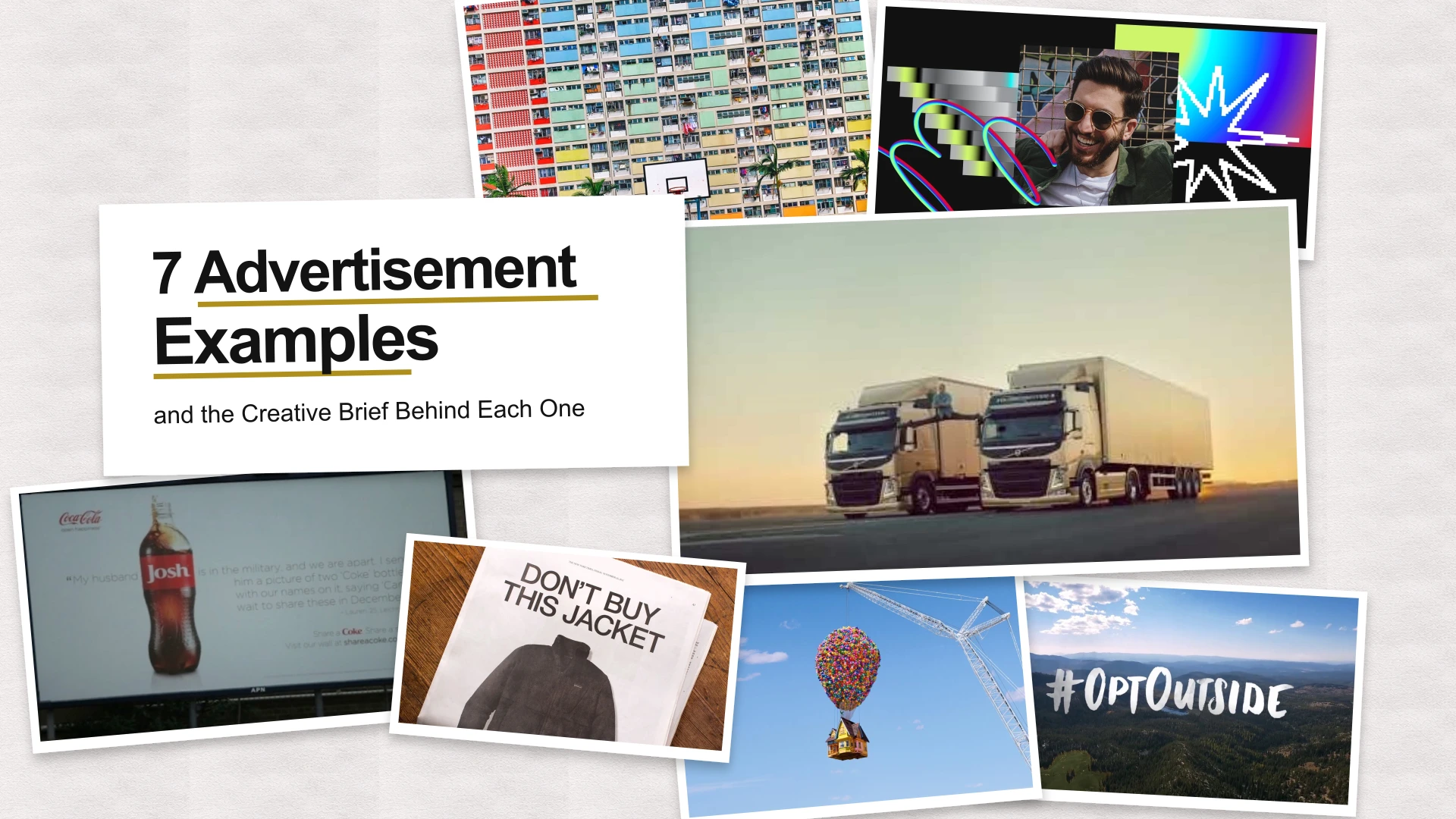
That's why these seven advertisement examples are worth reading with a brief in hand. Each one gives a creative team a different job, from making a steering system visible to giving an outdoor retailer's employees a day outside. The campaign links lead to the original work or the brand's account of it. The one-line briefs below are our reconstructions, written to help you apply the decisions to your own campaign. These are brand advertisement examples with explanations of the audience decision behind the work, rather than a gallery ranked by fame. Read them as advertising campaign case studies: the useful question is what instruction made each execution possible.
1. Share a Coke gave the customer someone to buy for
In Australia in 2011, Coca-Cola put popular first names where shoppers expected to see its branding. The shopper had a reason to inspect a row of otherwise interchangeable bottles. Finding a friend's name made the purchase an invitation. Coca-Cola's account of the launch explains how its Australian team developed the idea and introduced the named packs. See the original Share a Coke campaign.
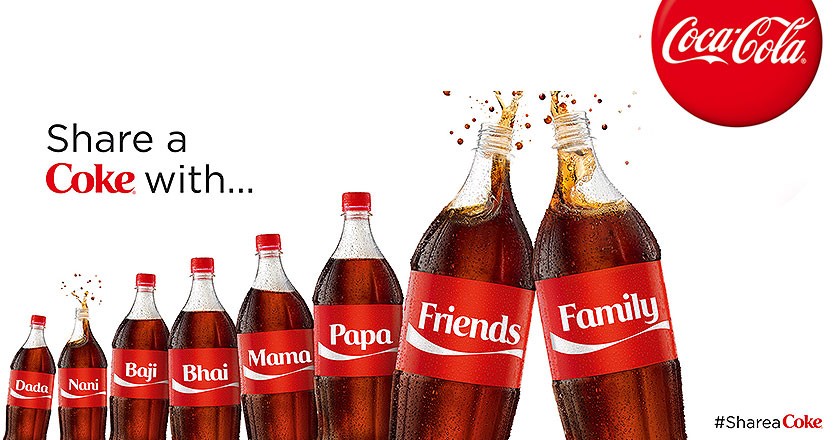
Our reconstructed brief: Among personalised advertising campaign examples, Share a Coke is unusually easy to explain because the pack carries the action. Give a young shopper a reason to buy a second Coke for a specific person. That's a more usable instruction than a request to increase brand engagement. A designer can act on it, a retailer can display it, and a customer can explain it to a friend.
Try it on your brand: Complete the sentence “I saw this and thought of you because ___.” A tea company might use a familiar occasion or a shared joke instead of a name. When you review product advertisement examples for brands, notice whether the pack, demonstration or headline gives the shopper a specific action. Before commissioning artwork, put three mock packs on a shelf. Can someone choose one for a particular person and explain the choice without reading the campaign copy?
2. Shot on iPhone let the picture make the claim
Apple selected ten photographs in its 2019 Shot on iPhone Challenge and announced that the images would appear on billboards, in stores and online. In the winners' gallery you can see the photographs, the credited photographers, the models they used and the judges' observations. That makes the work useful when comparing user generated content advertising examples: Apple selected and credited real submissions instead of disguising commissioned work as customer evidence. That's stronger material for a creative review than the generic direction “make the camera feel premium.” Explore Apple's winning photographs.

Our reconstructed brief: Let people judge the phone's camera by looking at a photograph large enough to stop them in the street. The product claim travels with the image through the campaign credit. The photographer's contribution matters too. A beautiful result shows what someone made with the tool, rather than what every owner should expect automatically.
Try it on your brand: List three things your customers produce with your product. Pick the output someone could assess without a sales explanation. For a design tool, that might be a finished poster beside its editable source. Establish who made it, how the product contributed, and what permissions you have before you turn it into an ad.
3. Volvo Trucks made precision visible in a single shot
Volvo's film opens on Jean-Claude Van Damme. As two reversing trucks move apart, the widening gap reveals the precision that the stunt demands. Volvo describes the controlled demonstration as a test of its Dynamic Steering system. Watch the film before reading the production details and notice when you first understand what the trucks are doing. Watch The Epic Split from Volvo Trucks.
Our reconstructed brief: Show a fleet buyer what precise steering looks like and give a wider audience a reason to watch until the demonstration is complete. The celebrity draws attention, but the trucks have to perform for the shot to work. That's a useful distinction when a team has money for talent and little clarity about what the talent will demonstrate.
Try it on your brand: Strong video advertisement examples for businesses let viewers see the claim happen. If you are learning how to turn product benefits into ads, choose one engineering benefit and translate it into a visible contrast. A packaging supplier could show what arrives intact after a controlled transit test. Document the conditions, decide what counts as a pass, and build a safe demonstration around that evidence. A viewer should be able to describe what the product did after the sound is turned off.
4. Spotify Wrapped gave creators something worth sharing
Spotify's account of its 2023 Wrapped work describes personalised share cards for songwriters and producers and a dedicated Songwriter Wrapped experience. A personal retrospective gives the recipient a reason to distribute it. Creative advertising examples with strategy connect that sharing behaviour to information the brand can credibly provide; here, Spotify holds the listening record behind each card. A generic year-end announcement gives that same person little to say beyond repeating the brand's message. See Spotify's account of Wrapped for artists and creators.

Our reconstructed brief: Turn a year of activity into a small piece of recognition that a creator can share in their own voice. The recipient becomes the subject of the story. The brand earns a place in the story because it holds the underlying activity record.
Try it on your brand: Ask what a customer would feel proud to share from their history with you. A learning platform might let someone celebrate completing their first project. Give the customer a preview and a choice about sharing. Check the underlying data before adding personal details, and avoid public rankings that might embarrass the very people you hoped to celebrate.
5. Airbnb Icons made the launch image explain the offer
Airbnb's 2024 summer release introduced Icons through experiences including a house inspired by Disney and Pixar's Up. Look at the image on Airbnb's release page and ask what you understand before you read a sentence. The familiar house gives viewers a quick route into the idea of staying somewhere they previously knew only through a story. For teams collecting advertisement campaign ideas for product launches, the lesson is to choose one image that demonstrates the category. It also belongs among brand storytelling advertisement examples because the audience recognises the story before it reads the product explanation. See the Up house in Airbnb's Icons launch.

Our reconstructed brief: Introduce a new experience category with one stay that makes its premise immediately understandable. That puts a useful constraint on creative development. The team has to choose a real experience vivid enough to carry the announcement.
Try it on your brand: If you have six new features, choose the one use case that explains why the launch matters. Photograph or film that use case first. Then show the opening image to someone unfamiliar with the product. Ask what they think they can actually book or buy. If their answer is more generous than your offer, revise the image or clarify the terms before launch.
6. Patagonia bought space for a difficult buying question
On Black Friday in 2011, Patagonia ran its Don't Buy This Jacket ad in The New York Times. The brand explains that producing even its own garments consumes resources. The product image and headline invite the reader to reconsider a purchase on a day built around shopping. Many print advertisement examples for brands depend on a large headline; this one also depends on Patagonia acknowledging the resources used to make its own jacket. The timing gives the headline a meaning it would lose on an ordinary Tuesday. Read Patagonia's account of the print ad.

Our reconstructed brief: Give a shopper permission to question whether they need another jacket, even while showing a jacket the company sells. That argument requires the brand to talk about the cost of making its own product. Borrowing the confrontational headline without that admission would change the substance of the ad.
Try it on your brand: Identify one occasion when you would advise a customer to wait, repair something, or choose a cheaper option. Check that your sales and service teams would give the same advice. If they would, you have the beginnings of a credible campaign. If they wouldn't, resolve the difference before turning it into advertising.
7. REI made its invitation credible by closing the stores
REI's Opt Outside began in 2015. The retailer closes its stores on Black Friday and gives employees paid time off. Patagonia used a print ad to ask a question about buying. REI attached an invitation to an operating decision that customers and staff could observe directly. Experiential advertising campaign examples become more credible when the company changes what people can actually do, rather than adding an event hashtag to an ordinary trading day. The two outdoor brands make a useful pair for a creative review because their mechanisms differ even when the calendar occasion is the same. Read REI's account of Opt Outside.
Our reconstructed brief: Give people a reason to spend Black Friday outdoors, and demonstrate the invitation by giving employees the day to do it. The operating decision supplies the evidence for the advertising. A social hashtag alone would leave the message with less behind it.
Try it on your brand: Ask what your company is prepared to do on the day the campaign goes live. A running shop might host a staffed beginner session with a published route and a clear capacity limit. Work out staffing, accessibility and the booking process first. Those decisions tell the creative team which promise it can safely put in the headline.
How to write a creative brief for a campaign
Famous advertising campaign examples can help you see a mechanism, but fame is not a brief. To understand what makes an advertisement effective for your audience, start with one person and one change you want them to make. This is also how to analyse an advertising campaign without copying its surface style. Describe the moment before they see the work. A shopper choosing a gift in a crowded aisle needs different evidence from a fleet manager assessing a technical claim. Write down what each person can already see, what they doubt, and what information they need next. That makes it easier to choose an example for its relevance rather than its fame.
The most useful creative brief examples for advertising campaigns connect a situation, observable evidence and a next action. Use this advertising brief template for creative teams: “When [person] is [in this situation], show them [observable evidence] so they can [specific next action].” Follow it with the constraints: the placement, available assets, permissions, approval owner and budget. Treat those fields as a creative campaign planning checklist and assign an owner to every approval. If the evidence only works in a long film, a small print placement may be the wrong commission. If it fits on the pack, the packaging team needs a seat at the first meeting.
Finally, define one test before producing variants. For a demonstration, ask viewers what benefit they understood. For a personalised pack, observe whether shoppers can find a suitable gift. Those tests answer narrower and more useful questions than asking which mock-up everyone likes. Build the media plan once you know what the advertisement must communicate.
If you're planning a launch, bring one product claim, one audience and the evidence you already have to a discovery call. Our advertising team can help turn that material into a production brief. For a campaign built around short-form video, use our Instagram production and marketing checklist to define who will script, film, approve and measure it.