n8n vs Activepieces: Which Automation Platform Is Better in 2026?
n8n suits technical teams building AI agents and complex workflows; Activepieces suits non-developers who want a simple builder and an MIT-licensed core. Here is how they compare and how to choose.
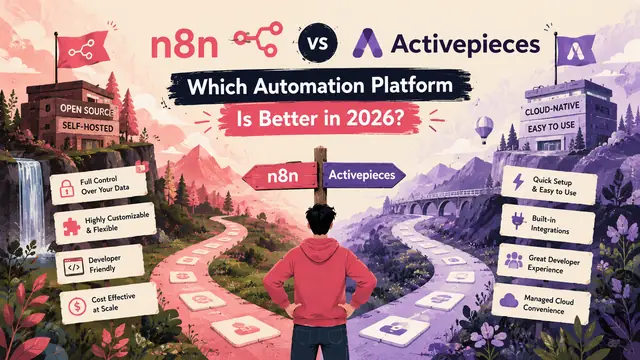
Choose n8n if a technical team will own your automations and you need code nodes, AI agent workflows and queue-mode scaling, and your use fits its fair-code Sustainable Use License. Choose Activepieces if marketers and operations staff will build most flows themselves, you prefer a Zapier-style step builder, or you want an MIT-licensed core you can embed. Both self-host on Docker and both sell a managed cloud.
n8n vs Activepieces at a glance
Both platforms replace repetitive work with triggered, multi-step workflows. They overlap on the basics (visual builder, webhooks, HTTP requests, self-hosting) and split on who they are designed for.
| Factor | n8n | Activepieces |
|---|---|---|
| License | Sustainable Use License (fair-code, source available); paid features under an enterprise license | MIT core (Community Edition); enterprise features under a commercial license |
| Self-hosting | Free Community Edition with almost the full feature set | Free Community Edition with unmetered runs, Docker or Helm |
| Cloud pricing model | Tiers based on monthly workflow executions; unlimited users and workflows | Free tier plus paid tiers based on monthly credits |
| Builder style | Node canvas with branching, merging, loops and expressions | Vertical step builder with branches, loops and retries |
| Custom code | JavaScript and Python Code nodes | Code steps with npm packages |
| AI | AI Agent node, vector stores, local models via Ollama | AI pieces and agents; pieces usable as MCP servers |
| Integrations | 400+ built-in nodes plus thousands of community nodes | A few hundred pieces, many contributed by the community |
| Scaling | Queue mode with Redis, Postgres and worker processes | Postgres and Redis; less published high-volume guidance |
| Best for | Technical teams, complex and AI-heavy workflows | Non-developers, Zapier migrations, embedding in products |
What n8n is built for
n8n is one of the most widely used workflow automation platforms for technical teams. It combines a visual canvas with developer-level control: JavaScript and Python code nodes, an HTTP Request node for any API, webhooks, database nodes and complex branching. Non-technical users can still build simple flows by dragging nodes, but the platform rewards people who understand APIs and data structures.
AI tooling is where n8n has pulled ahead. Its AI Agent node connects a chat model to tools such as search, databases or other workflows, then decides which tool to call. You can plug in OpenAI, Anthropic, Google Gemini or local models through Ollama, add vector stores for retrieval, and keep a human approval step before anything is published or sent. That makes it a strong base for content pipelines, lead enrichment and support triage. It is also the platform behind our n8n automation and AI agent development services, where we design, host and maintain workflows for teams that want the outcome without running the platform.
The trade-off is the license. n8n's Sustainable Use License lets you use, modify and self-host it for internal business purposes, and it lets agencies build and run workflows for clients on their own instance as long as clients only receive the outputs. Letting customers build or configure workflows inside your product, hosting n8n as a service, or white-labelling it requires a commercial license.
What Activepieces is built for
Activepieces is a newer platform focused on simplicity. Its builder feels familiar to anyone who has used Zapier or Make: a trigger, then a vertical list of steps, with branches, loops, automatic retries and versioned flows. Marketers and operations staff can usually ship a working flow in their first session without opening the documentation.
Its open ecosystem is the other draw. Integrations, called pieces, are written in TypeScript and published on npm, a large share come from the community, and pieces can be exposed as MCP servers for use with AI assistants. The Community Edition core is MIT-licensed with no metering on runs, which gives product teams more room to embed or extend it than n8n's license allows. Enterprise features such as SSO, audit logs and custom roles sit in a separately licensed directory.
Head-to-head comparison
Workflow builder and logic
n8n handles advanced logic better: merging branches, looping over items, expressions on any field and sub-workflows that behave like reusable functions. Activepieces keeps flows linear and readable, which helps when five different people maintain them. Edge: n8n for complexity, Activepieces for readability.
Integrations
n8n ships 400+ built-in nodes, and self-hosted instances can install community nodes from a catalogue that now runs into the thousands. Activepieces has a smaller library that grows weekly. Both fall back to an HTTP step for any REST API, so the practical test is how many requests you will build by hand for your specific stack. Edge: n8n.
AI capabilities
n8n offers the deeper toolkit for agents, retrieval and model choice, with thousands of community templates to copy. Activepieces supports the major model providers, makes simple AI steps (summarise, classify, extract) easy for non-coders, and its MCP support is useful if your team already works inside AI assistants. For multi-step agents with memory and tools, n8n is more mature. Edge: n8n.
Ease of use
This is where Activepieces shines. Teams moving off Zapier tend to be productive within a day. n8n's learning curve is steeper because data passes between nodes as JSON items, and that model takes a few workflows to internalise. Once it clicks, it is what makes n8n so flexible. Edge: Activepieces.
Self-hosting and scaling
Both install with Docker on a small server; our step-by-step guide to installing n8n with Docker shows the full setup. n8n has the larger self-hosting community and documented scaling options: queue mode splits work between a main instance and worker processes connected through Redis and Postgres, and paid plans add multi-main setups for high availability. Activepieces also runs on Postgres and Redis but has fewer published guides for high-volume deployments. If you expect thousands of daily executions, n8n has the clearer path. Edge: n8n.
Pricing
Self-hosting either platform costs only infrastructure and your team's time. On the cloud, n8n charges by monthly workflow executions regardless of how many steps each one has, so long workflows are cheap and high-frequency triggers drive the bill. Activepieces uses monthly credits with a free tier. Model your expected volume on both pricing pages before committing, since plan limits change.
Who should pick which
Pick n8n if you
- Have a developer or technical marketer who will own the automations
- Build AI agents, retrieval pipelines or content workflows with several model calls
- Need custom integrations with internal systems or databases
- Expect high execution volumes and want queue-mode scaling
- Run automations for your own business, or deliver outputs to clients from your own instance
Pick Activepieces if you
- Want non-developers to build and maintain flows
- Are moving a set of Zapier or Make automations and want a familiar builder
- Need a permissively licensed core to embed in your own SaaS product
- Run mostly app-to-app automations: form to CRM, CRM to Slack, invoices to accounting
Typical scenarios
A D2C brand's marketing team that wants to route new reviews to Slack, tag leads in the CRM and send a weekly performance digest will be productive faster on Activepieces. A growth team building a pipeline that pulls search data, drafts briefs with an LLM, checks them against brand rules and posts drafts to a CMS for approval will hit Activepieces' limits sooner and should start on n8n. A SaaS company that wants customers to build their own automations inside the product should look closely at Activepieces' MIT core or budget for an n8n enterprise license.
Pros and cons
n8n
- Pros: deep logic and data handling, mature AI agent tooling, large integration library and community, documented scaling
- Cons: steeper learning curve, fair-code license limits reselling and embedding, complex workflows need documentation discipline
Activepieces
- Pros: fastest onboarding for non-developers, MIT core, clean versioned flows, MCP-ready pieces
- Cons: smaller library, fewer advanced logic options, less published guidance for high-volume self-hosting
How to choose in one week
- List three real workflows you want running next quarter, with their triggers, apps and expected monthly volume.
- Search both integration libraries for every app on the list. Each missing connector is an HTTP request you will build and maintain.
- Decide who builds and who maintains. If the answer is marketing ops without engineering help, weight ease of use heavily.
- Read each license against your business model. Internal use is fine on both; reselling or embedding is where they differ.
- Build the hardest of the three workflows on both free tiers. Time it and note where you got stuck.
- Estimate cloud cost at your volume, then compare it with a self-hosted server plus a few hours a month of maintenance.
If you are still weighing a managed plan against your own server, our breakdown of self-hosted vs cloud workflow automation covers cost, security and upkeep. For a wider field that includes Windmill, Kestra and Node-RED, see our comparison of the best open source workflow automation tools. And if the decision is really between a suite like HubSpot and something built for you, read marketing automation platforms vs custom AI agents.
Want the workflows without the platform overhead? Send us the three workflows from step one. Our custom software and automation team will tell you which platform fits, what it would take to build them, and how we would host and maintain them.
FAQ
Is n8n better than Activepieces?
For complex logic, AI agents and high-volume self-hosting, n8n offers more. For non-developers and straightforward app-to-app automations, Activepieces is faster to learn, and its MIT core is easier to embed in a product.
Is n8n open source?
n8n is source available under its Sustainable Use License, a fair-code license. You can self-host and modify it for internal business use at no cost, but hosting it as a service or letting outside users build workflows requires a commercial license. Activepieces' Community Edition is MIT-licensed.
Can both platforms be self-hosted?
Yes. Both offer a free Community Edition you can run with Docker on your own server, with paid licenses for enterprise features such as SSO and audit logs.
Which platform has better AI integrations?
n8n, today. Its AI Agent node, vector store integrations and support for local models through Ollama make it the stronger base for agents and retrieval workflows.
Can I migrate from Zapier to either one?
Plan to rebuild each Zap by hand on either platform. Activepieces' step builder maps closely to Zapier's model, so the rebuild is usually faster there.