YouTube Ads Are Turning Into Storefronts: The New Creative-to-Commerce Playbook
YouTube video, creator proof, product feeds, offers and checkout are becoming one campaign system. Here is how brands should redesign the workflow.
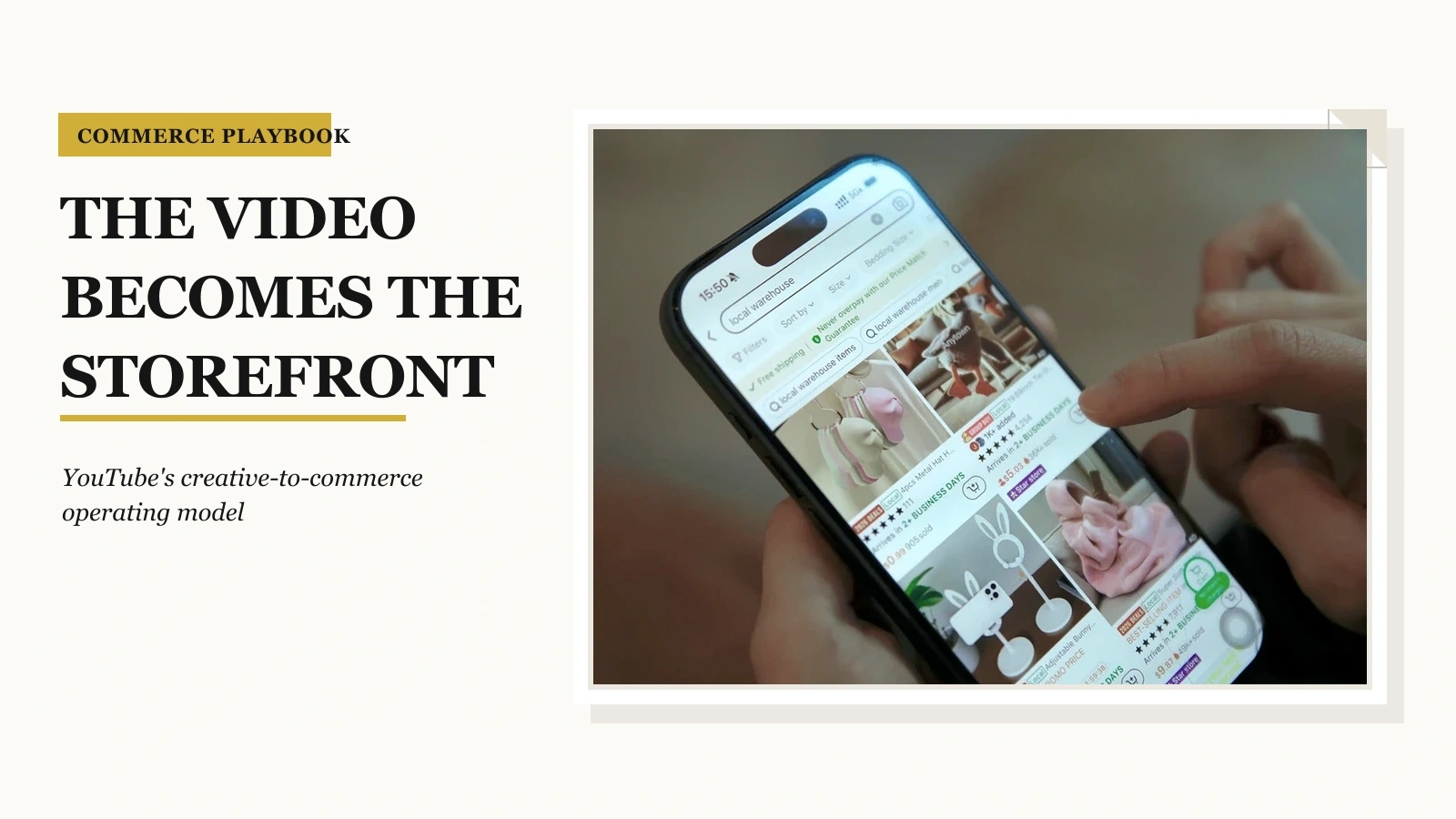
The best-performing video may soon be the one that removes the next three steps to purchase. Google’s November 2026 Demand Gen update brings product feeds, checkout links, creator-content boosting, promotion assets, and short-term bidding adjustments into a tighter commercial system. The strategic shift is larger than a new ad format: YouTube video, creator endorsement, media delivery, merchandising, and transaction are beginning to operate as one unit.
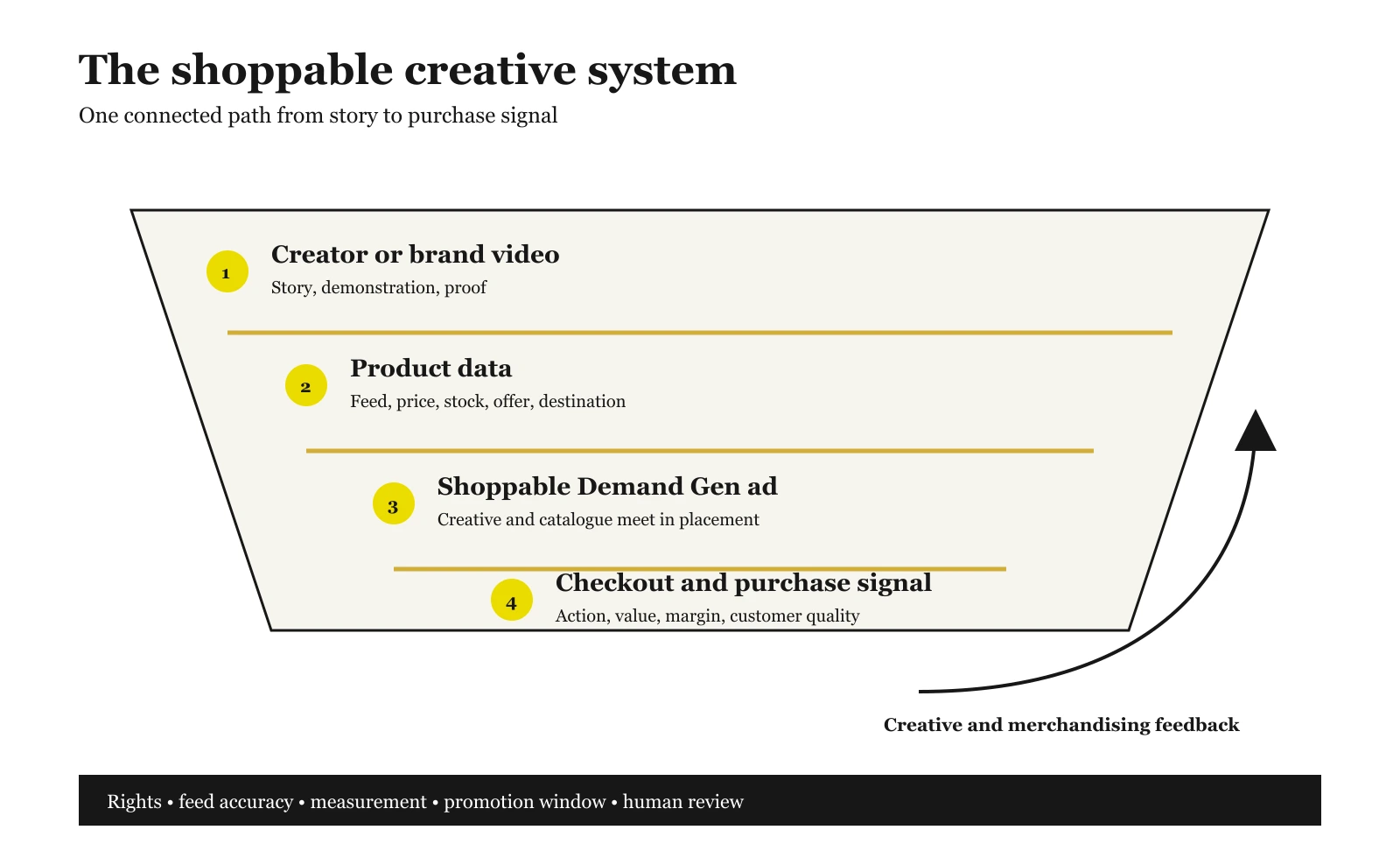
Brands should treat shoppable YouTube ads as a creative and operating-model problem, not simply a media feature. The new campaign unit is a shoppable creative system: a repeatable connection between the story people watch, the product they see, the proof they trust, the offer they receive, and the route they use to buy.
This is the practical creative-to-commerce playbook. Video can build desire while a Merchant Center feed supplies current products, a creator supplies credibility, and a checkout link shortens the path. None of those components guarantees performance. Google’s published results are platform or advertiser case studies, and they should be treated as examples rather than forecasts.
What changed in Google Demand Gen
YouTube Demand Gen product feeds can connect a video or image campaign to products from Google Merchant Center. Google describes these formats as virtual storefronts across YouTube and other eligible surfaces. A shopper can move from the creative to a product or, where the feature is eligible, closer to checkout.
YouTube checkout links need careful scope. Google’s Merchant Center documentation says the checkout annotation is currently available in the United States on some YouTube and display ad formats, appears on mobile and tablet rather than desktop, and is shown only when Google’s systems decide it is relevant. It also requires a valid cart or checkout URL that does not force sign-in. Brands must not build a global plan around an annotation that has narrower availability.
The update also strengthens creator partnership ads on YouTube. An advertiser can link an eligible creator video to Google Ads and use that organic content in paid campaigns, including supported Demand Gen placements. The advertiser remains responsible for sufficient usage rights. The media team cannot treat creator permission as a loose email agreement if the asset will become paid advertising.
Finally, Demand Gen seasonality adjustments allow teams using Target CPA or Target ROAS for Demand Gen to tell Smart Bidding about an expected, short-lived conversion-rate shift. Google recommends the tool for brief events, generally one to seven days, rather than long promotional periods. This is a bidding control for unusual moments, not a substitute for a clean offer, accurate feed, or strong creative.
The gap between video and transaction is collapsing
Traditional video commerce advertising often hands the shopper through several disconnected steps: watch the video, remember the product, visit the website, find the item, confirm the offer, and complete checkout. Every handoff can introduce delay, mismatch, or abandonment.
Demand Gen shopping ads compress that route. A product feed can make the item shown in the video immediately identifiable. A creator can provide context. Promotion assets can make a live offer visible. Checkout or product links can move the shopper towards the exact item. The creative stops being a top-of-funnel object and becomes the front end of a commerce system.
This does not mean every brand video should become a catalogue. The strongest shoppable video campaign strategy keeps the narrative clear, then makes the next action obvious. A film about a running shoe should not interrupt every second with price cards. It should make the shoe, use case, proof, and route to purchase coherent.
Build one shoppable creative system
| System layer | Primary job | Failure to prevent |
|---|---|---|
| Story | Create a reason to care and a memorable product role | Attractive video with no buying logic |
| Creator proof | Demonstrate use, fit, or credibility in a recognisable voice | Paid creator content that feels detached from the offer |
| Product feed | Supply accurate titles, images, price, availability, and destination | A good ad leading to the wrong or unavailable item |
| Offer | Make the promotion and its conditions understandable | A discount that changes between the ad and checkout |
| Media | Match creative, products, audience, and timing | Optimisation that rewards cheap actions instead of useful sales |
| Measurement | Connect exposure, product interaction, checkout, and value | Crediting the video while ignoring feed or landing-page failure |
Teams asking how to make YouTube ads shoppable should begin with this shared system map. The creator brief, product feed, offer calendar, media plan, and measurement specification need one owner or a defined handoff. Separate channel meetings will not fix contradictory information at the moment of purchase.
Design the video and product feed together
YouTube ads with product feed should not be assembled after the edit is finished. The shot list needs to anticipate which products will be eligible, how clearly they can be identified, and what variations or bundles may appear. The feed team needs to know which product image, title, price, stock status, and landing page will support the film.
Google recommends enough eligible products for the format to work, and its documentation suggests at least four products for eligibility with a larger catalogue preferred. It also recommends landscape, square, and vertical videos so the system can serve across YouTube and Shorts. That makes product feed video ads a production system with multiple compositions, not one master film cropped at the end.
For YouTube Shorts shopping ads, the opening frame must earn attention before product information can help. Show the product role early, keep key actions within the mobile frame, and make the spoken claim match the product page. A feed can shorten navigation, but it cannot repair a vague promise.
Make creator content usable in paid media
A Demand Gen creator partnerships boost can extend a strong organic creator video through paid distribution. Before launch, document the asset, account-linking process, paid usage term, territories, editing rights, disclosure, product claims, and what happens when the agreement expires.
YouTube creator content ads also need a brand-safe landing experience. If the creator recommends one product for one use case, do not send the viewer to a generic category page with twenty unrelated items. Preserve the promise from voice to product page to checkout.
Our Instagram production and marketing checklist covers the same operational question across short-form creator content: who scripts, films, approves, distributes, and measures the asset. Work With AI’s advertising practice can connect the creative brief to media execution.
Use promotion-aware bidding without surrendering judgement
Promotion-aware bidding is most useful when the team knows why conversion behaviour will be temporarily different. Record the event, expected conversion-rate change, campaign scope, start and end time, budget limits, and the business evidence behind the estimate. Review whether the adjustment improved profitable demand, not simply whether it increased conversions.
Google’s seasonality guidance warns against using adjustments for extended periods. A four-week sale, weak proposition, or broken checkout is not a short-term anomaly. Media automation should receive better commercial context, not be asked to compensate for an unclear campaign.
Measure the system, not only the video
YouTube ecommerce advertising needs reporting that separates creative attention from product and transaction quality. Track video engagement, product clicks, eligible product coverage, destination errors, checkout progression, order value, contribution margin, returns, and new-customer quality where the data is appropriate.
Merchant Center product feed ads can fail because a product was disapproved, out of stock, incorrectly priced, or sent to a poor mobile page. Give feed health a place in the campaign review. A declining conversion rate may be a merchandising issue rather than creative fatigue.
Google cites advertiser results from Petco, Javvy, and Shopee in its announcement. Those cases can show what the tools were designed to support, but they do not establish a typical uplift for another brand. Treat any reported result as a case with its own category, budget, creative, market, and measurement conditions.
A 30-day creative-to-commerce pilot
- Week 1, choose the buying moment. Select one product group, one audience situation, and one measurable commercial action. Audit feed quality and mobile destinations.
- Week 2, create the system brief. Connect the story, creator role, product set, offer, rights, formats, checkout route, and success measure in one document.
- Week 3, launch a controlled test. Use the smallest useful set of videos and products. Keep one clear comparison so the team can identify whether creative, feed, audience, or destination changed the result.
- Week 4, review the whole path. Compare attention, product interaction, checkout behaviour, margin, and operational errors. Turn the result into the next creative brief.
The operating model matters as much as the ad format. Video, creators, Ad Tech, merchandising, and commerce must share one campaign definition. Teams choosing the wider stack can use our 2027 digital marketing platform guide.
The storefront now begins inside the story
Choose one upcoming product campaign and map every step between the first frame and a completed order. If the viewer must search, reinterpret the offer, or rediscover the product, the creative system still has unnecessary distance.
The opportunity is not to add more shopping badges. It is to make story, proof, product data, offer, delivery, and transaction feel like one honest experience.